
Loading...
Loading...

Updated October 27, 2026. General information, not tax advice.
Export the order history from every store your business buys from, tag each item with a consistent expense category, flag mixed-use, large and returned items, and save the files in a dated folder with a backup. Repeat monthly or quarterly.
Digital records are fine with the IRS. What matters is that each one shows who you paid, how much, when, and what you bought.
Missing receipts for online orders?
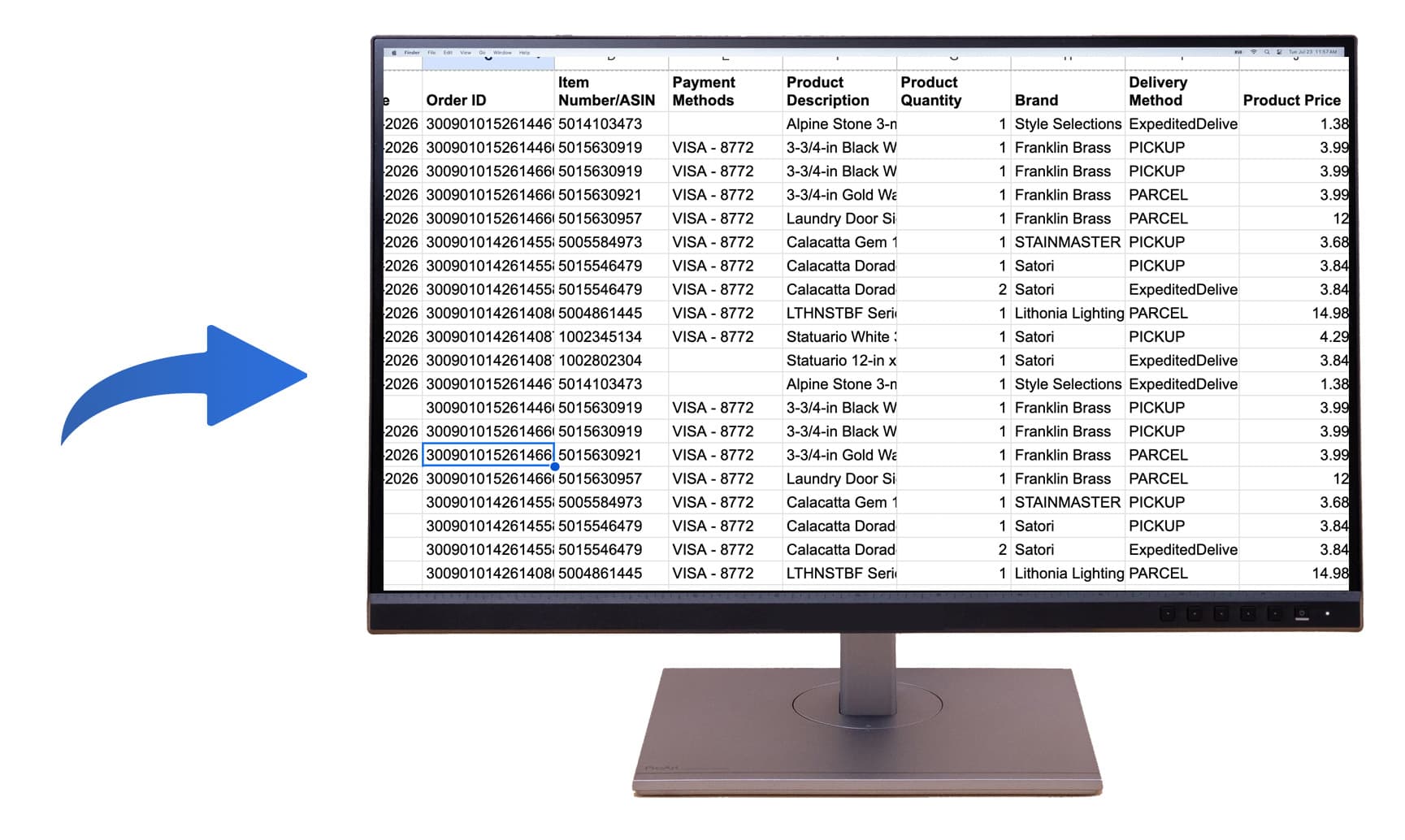
Export every order with item-level detail into one spreadsheet.
Most small business owners don't overpay tax because they missed a clever strategy. They overpay because of missing paperwork. A receipt you can't find is an expense that often doesn't get claimed.
Online shopping makes this both easier and harder. Easier, because every purchase is recorded somewhere. Harder, because those records are scattered across Amazon, Walmart, Target, Temu, eBay and your inbox, and they're mixed in with personal orders. Here's a simple system for pulling them together before tax season.
The IRS doesn't require a specific format, and electronic records are accepted. Your records should show:
A bank or card statement alone usually shows only the store and the total. It won't show that a $187 Amazon charge was toner and shipping boxes rather than a personal purchase. That's why itemized order details matter, with the statement as backup proof of payment.
| Situation | Keep records for |
|---|---|
| Most returns | 3 years from the date you filed (or 2 years from when you paid the tax, if later) |
| Income underreported by more than 25 percent | 6 years |
| Equipment and other depreciated assets | Until the limitation period ends for the year you sell or dispose of the asset |
| Employment tax records | At least 4 years |
| Bad debt or worthless securities deduction | 7 years |
| No return filed, or a fraudulent return | Indefinitely |
List every store and platform where your business buys things. For most small businesses that's two to five sites. Then export the full order history from each one.
Doing this by hand means opening every order and copying item details. The OrderPro Analytics Chrome extension exports Amazon, Walmart, Target, Temu and other order histories into one spreadsheet with item-level detail, which saves hours if you place a lot of orders. For anything that only exists as an email receipt, save it as a PDF into the same folder (see Step 4).
Pick a set of categories and stick with them all year. Lining them up with the lines on your tax return (Schedule C for sole proprietors) makes the handoff to your accountant or tax software much smoother. A starter list:
Not sure where something goes? Our Schedule C guide for online purchases maps common purchases to the right line.
Skip the hand sorting
The Purchase Categorizer assigns a tax category to every item and flags business, personal or mixed, so you only review.
No automatic system is perfect, so set aside time for a quick review. Watch for:
A simple folder structure goes a long way:
/Taxes/2026/Expenses/ categorized order exports, one file per store or one combined
/Taxes/2026/Receipts/ PDFs for large or unusual purchases
/Taxes/2026/Notes/ business-use percentages and explanations
Name receipt files with the date, store and amount, for example 2026-03-14_amazon_187.42.pdf, so they sort in order and match your bank statement at a glance. Back the whole folder up to cloud storage. If you're ever asked to support a deduction, you can pull the record in minutes.
The businesses with the easiest tax seasons don't do anything fancy. They keep up. Exporting and categorizing orders once a month or once a quarter takes a fraction of the time it takes in April, and it makes quarterly estimated tax payments and cash-flow planning more accurate.
Yes. The IRS accepts electronic records, including emailed receipts, scanned paper receipts and order exports, as long as they are accurate, legible and you can produce them if asked. You do not need to print online order confirmations.
A business record should show who you paid, the amount, the date, and a description of what you bought that is detailed enough to show its business purpose. Proof of payment, such as a card or bank statement, supports the record.
Generally at least three years from the date you filed the return, or two years from the date you paid the tax if that is later. Keep them six years if you underreported income by more than 25 percent, seven years for a bad debt or worthless securities deduction, and keep records for equipment or other depreciated assets until the period of limitations expires for the year you sell or dispose of them.
A card statement proves payment but usually not what you bought. A line reading AMAZON $187.42 could be toner or a personal purchase. Pair it with an itemized order record or receipt.
Monthly or quarterly. Small, regular sessions take far less time than reconstructing a full year in April, and they make quarterly estimated tax payments more accurate.
Get every online order into one spreadsheet, ready to categorize and file.
Export my order historyThis article is for general information only and is not tax, legal or financial advice. Tax rules change and the right treatment depends on your situation. Before you file or act on anything here, talk to a licensed tax professional, such as a CPA or IRS enrolled agent.